

AI you can put
in production.
Most AI demos break the moment real data hits them. We build the systems that don't: pipelines that check their own work, retrieval grounded in real sources, and the evaluation that proves it keeps working. The top of this page is for business owners. Scroll down for the proof your engineers will want.
Running On
5
AI Systems in Production
Document AI, RAG, voice, evaluated NLP, LLM tutoring.
4
Cloud & Model Providers
AWS, GCP, Gemini, and a multi-provider fallback chain.
100%
Shipped with Evaluation
Every system measured against gold data, not vibes.
48h
Zero to Deployed Service
A finance document engine, live with CI/CD in two days.
What AI actually changes in an operation.
Not "AI transformation." Three concrete shifts, each one we have shipped for a real business.
Manual paperwork runs itself
Invoices, forms, and documents read, validated, and entered without a human re-typing them. The system flags what it isn't sure about instead of guessing silently.
Knowledge becomes answerable
Your policies, records, and history turned into something staff and customers can ask in plain language, with answers that cite where they came from.
AI you can actually trust
Every system ships with tests that measure whether it's right, logging that tracks what it costs, and limits on what it's allowed to do. No black boxes.
Capabilities, each backed by a system we run.
Plain claim on top. The engineering that backs it, with the real stack named, underneath. We don't reach for AI by reflex; we reach for what the problem needs.
Engineered for agentic pipelines
Multi-step LLM workflows that route, extract, verify, and self-correct, built as explicit state machines instead of brittle prompt chains.
- a finance document engine
- LangGraph state machine, classify → extract → verify → finalize
- failure escalates to a stronger model, then bounded self-correction
- deterministic checks gate every output
Built for retrieval & document AI
Turning documents, archives, and knowledge bases into something people can ask in plain language, with answers grounded in real sources, not hallucinated.
- a learning platform indexing cloud documentation as vector embeddings
- semantic search with cited answers
- Gemini structured output
- OCR for scanned input
- BM25 / pgvector retrieval
Measured, not guessed
We measure whether the AI is actually right, on a gold-standard dataset, before and after every change. And we track what it costs.
- domain-specific accuracy metrics (UAS/LAS) scored against a gold treebank on an Arabic grammar engine
- pytest eval harnesses vs golden data
- token-and-cost logging
- Langfuse / LangSmith tracing
Shipped like real software
AI services that ship like real software: authenticated, monitored, containerised, on CI/CD. Not a notebook, not a demo.
- async FastAPI services on Cloud Run
- JWT auth
- structured logging
- lint / type-check / tests in CI
- an exam-prep platform and a document engine both shipped this way
Designed for voice & conversation
Real-time voice agents that qualify, answer, and route, and an accessibility-first product where voice IS the interface, not a bolt-on.
- a voice-driven, screen-reader-native study app built for blind and low-vision users first, with its own harness that evaluates the voice AI
- Vapi agents with tool calling into internal APIs
Trustworthy by design
Confidence a business owner can act on, derived from checks the model cannot fake, not from the model's opinion of itself.
- deterministic cross-checks override LLM self-reported confidence
- hard caps on any verification failure
- humans review exactly the cases that need it, and trust the rest
Real systems, shipped and running.
A range of problems, each solved with the AI approach the problem actually needed. Names available on a call.
Finance document engine
DOCUMENT AIReads invoices and statements, digital or scanned, and returns structured, verified data. Deterministic checks catch the model when it's wrong, so a human only reviews what genuinely needs it.
Cloud knowledge platform
RAGIndexes a large body of cloud documentation as vector embeddings and answers questions grounded in the retrieved articles, with semantic search and a chat assistant that cites where its answers come from.
Accessibility-first voice app
VOICE AIA study companion built for blind and low-vision users first: navigate, read, and search entirely by voice, keyboard, and audio. Ships with a harness that evaluates the voice AI and the accessibility itself.
Exam-prep AI tutor
LLM PRODUCTGives students instant, syllabus-aligned help: ask questions, generate practice, get structured explanations. Pluggable model providers behind a clean API, with token and cost logging built in.
Arabic grammar engine
EVALUATED NLPParses classical Arabic grammar and is scored on every change against a gold-standard treebank using the metrics computational linguists use for exactly this task. We measure accuracy, we don't claim it.
A real pipeline, not a prompt.
The shape of our document-processing engine: a state machine where the model does the reading and deterministic code keeps it honest.
classify
Detect digital vs scanned, route to the right extractor.
extract
The model reads the document: digital-text path or OCR path.
verify
Deterministic math: totals reconcile to the penny, line sums, rate-by-code.
finalize
Attach failed checks, derive honest confidence, return.
on failure verify routes back: first a retry on a stronger model, then bounded self-correction, capped so it can never spin forever. Line-level issues are reported but never trigger a retry, because correcting a correct header can break it.
The engineering, explained without the source.
We keep our clients' code private, so instead of pasting it here, this is how we think. Three decisions from real production systems. The pattern is the proof: each choice is tied to the domain and the business outcome, not picked off a tutorial.
An LLM never has the last word
↺ fails → retry on a stronger model, then re-verify
The decision. A finance workflow cannot tolerate a confident wrong answer. So the model reads the document, but deterministic code checks the result. Only when the numbers genuinely fail to reconcile does it earn a retry, on a stronger tier first. Reliability is designed in, not hoped for.
We ignore the model's confidence in itself
The decision. A model will report itself highly confident even when it is wrong. So we throw that signal away and derive confidence only from things it cannot fake: does the arithmetic add up, is the output internally consistent, did it follow the steps we required. A reviewer then sees exactly the cases that need a human, and trusts the rest.
We measure success the way the field does
The decision. This is a dependency-parsing problem, so we don't invent a metric. We use what computational linguists use to judge exactly this task (UAS and LAS), scored against a gold-standard Arabic treebank, per genre and per source, on every change. We researched the field before we chose how to call it accurate.
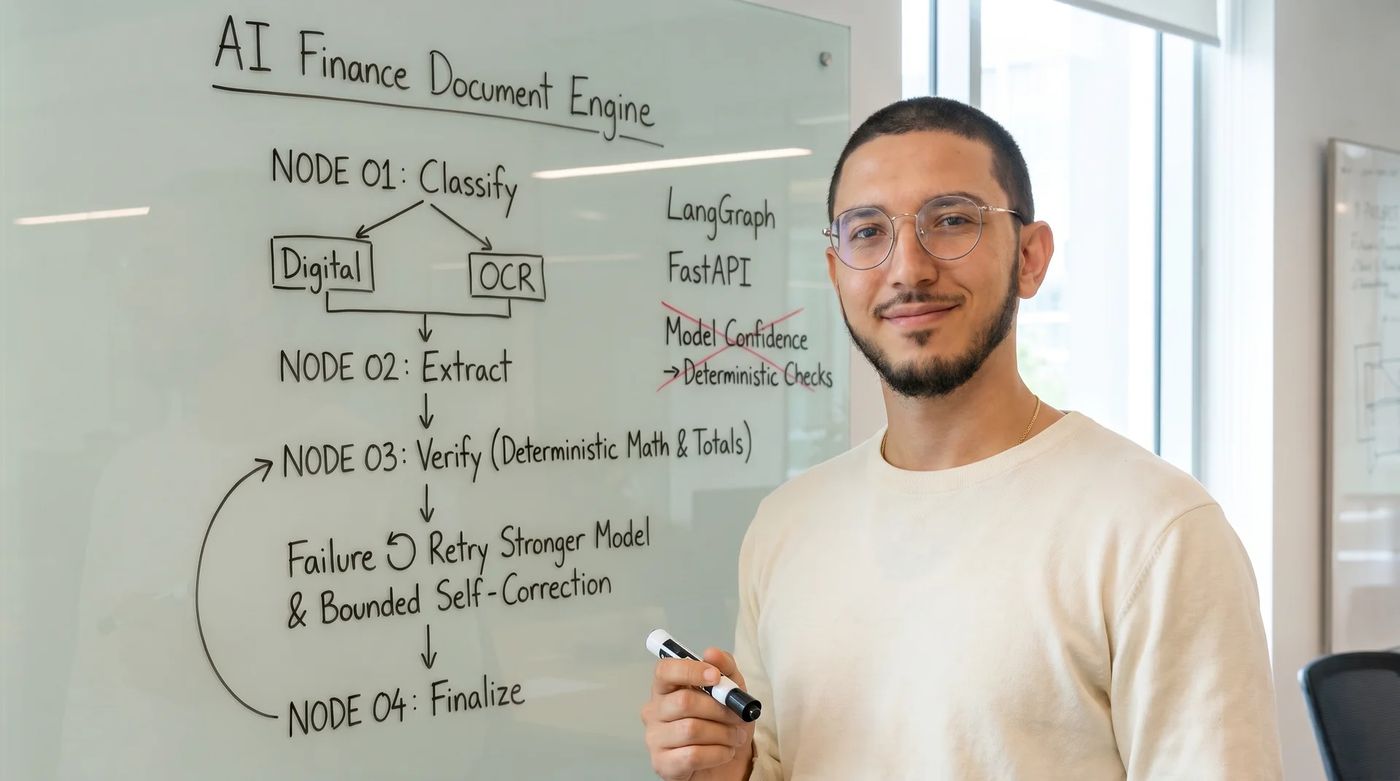
The engineering happens on the whiteboard before it ever reaches a prompt. Talk to Hamza and the team about your hardest problems.
Bring us something hard.
A workflow you think can't be automated, an archive nobody can search, a process drowning in manual review. Talk to the engineers who would build it, 15 minutes, and we'll tell you straight whether AI is the right tool.
Let's streamline your operations.
Tell us a bit about your workflow and choose how you’d like to continue.
Save 10–20+ hours weekly
Auto-pilot redundant data copy/pasting processes automatically.
Reduce human error
Verify data constraints and system integrations automatically.
Built for how you operate
Tailored platforms that fit your staff's actual workflow rules.
Secure, scalable, and reliable
Modern client portals backed by strict authorization structures.